Sunday, May 15, 2022

Two Hundred Years of Progress?

 I had the opportunity to look at some cyphering books from the 19th century this past week, and found a problem I thought interesting.  Ciphering books were books in which students copied math problems and solutions, often after first solving them on a slate and getting the approval of their teacher.  The books served as both math notebooks and reference books, and were often kept by students as they entered the business world, and sometimes passed from one member of a family to another.


Here's a page from a book composed by Christopher Render around 1800.  The book is part of the Ellerton-Clements Cyphering Book collection at the Library of Congress.  The collection has not been digitized, unfortunately, so is only available to those visiting the Manuscript Reading Room of the Library.

The problem at the top of the page reads: "Two men depart from one place suppose them to be James and Jerry.  James starts and travels 26 miles [per] day, seven days after Jerry starts and travels 37 miles [per] day.  I demand in how many days and in how many miles travel will Jerry overtake James?"

The first thing I thought about this was that the problem sounds very much like some of the word problems in modern text books.  Also, who travels 37 miles each day consistently until they catch up with someone else?!  (Apparently, I feeling a little salty about these types of problems.)  It turns out that many of the word problems posed to students in the 19th century came after the statement of a rule, possibly with explanation but often not, perhaps an example, and several (or many) practice problems without context.  The word problem itself provided information very much like the practice problems.  If a type of problem had a number of different variations, the rule would be broken up into cases, each with its own example, practice, and word problems.  After a few rules (and lots of practice problems) there would be a section called "Promiscuous Problems" or what we call in modern books, "Mixed Practice".

There's much more to look at on this page, but I'll write about Christopher's calculations later.  Right now, I just want to sit with the knowledge that many of the currently available textbooks and what students are often currently required to do looks very similar to what was happening over 200 years ago.  Have we really learned so little about how students learn math?!

Saturday, May 7, 2022

Stretching with STEM Yoga!

A few weeks ago, I ran a short online session with the folks in my office.  It's part of a series my fellow Einstein Fellow and I dubbed STEM Yoga, to help stretch our thinking about using primary sources in STEM classrooms.  Most of the rest of the folks in the office have a background in the Humanities, so we've tried to tailor the series to be accessible to a wide audience.

I started out by showing this item (https://www.loc.gov/item/92518152/), and asking everyone to Notice and Wonder, a thinking strategy I've been using for a long time after seeing Annie Fetter give a talk about it at a conference, and later at a Metropolitan Math Club of Chicago dinner (Short video here: https://www.youtube.com/watch?v=a-Fth6sOaRA, and more on "Notice and Wonder" here: https://www.nctm.org/noticeandwonder/.  The Library of Congress uses a variation called "See, Think, Wonder" or "Observe-Reflect-Question" https://www.loc.gov/programs/teachers/getting-started-with-primary-sources/guides/).  

There were lots of items to notice in the picture:

  • It is a woodcut.
  • There are two men sitting at desks with an angel holding books in between.  (I pushed the thinking on this one, and asked "How do you know it's an angel?"  The answer was "She looks like she's floating and she has a halo.")
  • There is a ribbon with words on it, possibly in Latin.
  • One desk has math symbols on it, the other has an abacus.
  • The man with the abacus has a pile of coins by his right hand.
There were some other things to notice as well, and then we went to questions:
  • What do the Latin words mean?
  • Is it really an abacus?
  • Who made the drawing and why?
  • Is this an allegory?
  • Who are these people?
  • What do the numbers mean?
We discussed which questions could be answered quickly, and which my take additional digging.  Quickly, we determined that the Latin writing was two names: Boethius and Pythagoras (on the ribbons near the two men) and the phrase: "Types of Arithmetic".  We also looked at the item record from the Library of Congress (scroll down on the linked page with the image) to find out the appeared in a book by Gregor Reisch in 1503, Margarita philosophica.  This led to all sorts of other questions about who these people were and what else was in the book.  Since that would require additional research, we moved on to the question about the "abacus".

I explained that it was probably not an abacus, as it has no frame, and is probably a medieval counting board.  This would have been made of lines on a table separating the space into regions representing ones, tens, hundreds, and thousands (and more decimal places as necessary).  The beads are actually counters called "jettons" (French for "token"), and the pile of coins under the man's hand were spare jettons*.

I asked if anyone knew how an abacus or counting board worked, and no one was really sure.  So to illustrate, I demonstrated how James Tanton's "Ten-One machine" from his "Exploding Dots" lessons worked.  I showed how the number 5 could be represented by five dots in the first (1s) box, and 10 by ten dots in the first box or one dot in the second (10s) box.  We talked about the meaning of the boxes, and then a bit about language:
  • 12 could be represented by twelve in the one's box, or one 10 and two 1s, but then we might read that as "two-teen", just like 14, 16, 19, etc.
  • Also, numbers like 42, 62, 92 are all read like "four-ty two" (four tens and two) or "six-ty two" (six tens and two), by 22 is not "two-ty two" because the English way to say numbers has some roots in base 20.
  • "Eleventy" (110) was an actual word at one time (and not just from Tolkien)!
  • We can read the number 1200 as "one thousand, two hundred" (one token in the 1000s space and two in the 100s place) or as "twelve hundred" (twelve tokens in the 100s space).
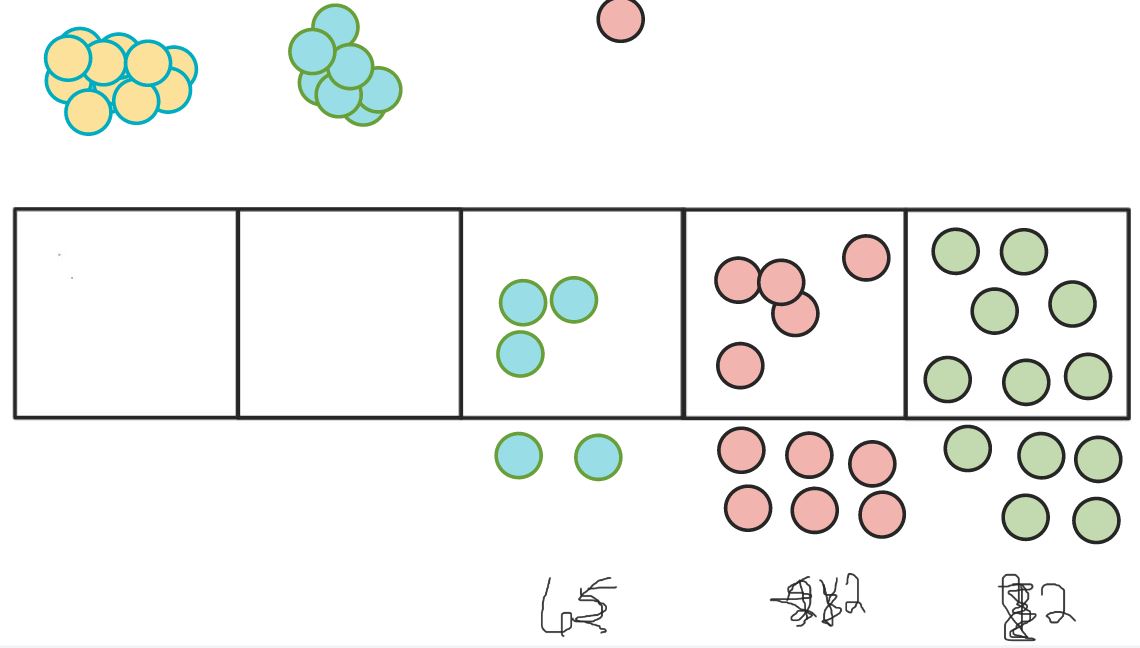
The word play got everyone excited (did I mention they are mostly Humanities folks?) and they were ready to try representing some numbers on their own.  I gave them a google jamboard with tokens and a counting board, and asked them to represent 357.  No problem.  Then I asked them to represent 265 just under that, and add the two numbers together using the tokens.  Here's a screenshot of what one of them did:
Others moved the jettons around:
And several folks explained their thinking, with several different methods.  Some translated to numbers, some worked left to right, and some right to left.  They asked each other a couple questions, and one person who had made a mistake originally talked about what she was thinking and what she learned.

We went back to the original picture, and folks said they could translate the numbers on the counting board, but wondered if the 1s was at the top or the bottom as they looked at the picture, and if the numbers meant anything.  We now had more questions to research.  And those Humanities folks (who often cringe about math) said they enjoyed and understood what we were doing!

As James Tanton would say, it was "brilliant"!

* You can read more about jettons in this book, by Francis Pierrepont Barnard, published in 1916: https://babel.hathitrust.org/cgi/pt?id=mdp.39015017345441&view=1up&seq=4&skin=2021, and this page has another example of addition: https://babel.hathitrust.org/cgi/pt?id=mdp.39015017345441&view=1up&seq=257&skin=2021.
 

Wednesday, March 16, 2022

Rollercoasters Are Scary!

The other day, I was giving my midyear presentation for the Einstein Fellowship, and talked about how I filter everything I do and learn through the lens of going back to the classroom.  I know that's where I belong, teaching math to students is what I do best, and watching them grow personally and mathematically is what I enjoy.

HOWEVER ...

As much as I am excited to go back to the classroom in August, I am just as afraid.  I won't have been in front of a class of students in over two years, thank you not at all, covid.  My experience as a Fellow has been so different from the experience of my colleagues, and even more so, as they've taught remotely, in a hybrid setting, and with masks on every day.  That's a situation that can bind people together, and I'm not there.  Additionally, my school has switched from a nine-period-a-day, 42-minute class period schedule to a block schedule with 85 minute periods.  The closest I've been to a block schedule is teaching summer school.  Also, I think two of the courses I have most recently taught have gone through some curriculum changes, and I think the third is in process.

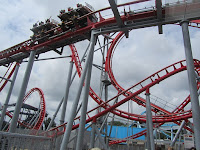
Partial view of a rollercoaster with twisted red track and grey supports.  A two-car train, filled with people, sits on the track at the top of the photo.

The upshot is that at an age where I should probably start thinking seriously about retirement, I will most likely feel like a brand new teacher all over again.  That scares me; that's a discomfort I've not felt in a long time.  And it's a feeling I've been missing.  I applied for the Fellowship to shake me up a bit.  Well, I've been shaken, stirred, spun around, and turned upside down the last two years, and it's been great.  So while the roller coaster I'm going to be on next year will be familiar in some ways to the one I left two years ago, there will be new twists, unexpected drops, and exciting turns.  It's going to be scary.

And it's going to be fun.


Photo by Ittsky from pixabay.

Wednesday, March 9, 2022

Remember ...

Since I started teaching umpteenish years ago, I have only been out of the classroom for six years.  First, when I took off a year to start my Masters degree, then three years as Department Chair, and now two years working on a Fellowship with the Library of Congress.  Being outside the classroom this time has allowed me to really indulge my curiosity and flex my writing muscles in ways I never have before, and I'm always happy to share what I learn with others.

This week, I've been working on a webinar that a colleague and I are making about teaching with primary sources.  We presented our draft to another team member, who asked at the end, "So, what does this look like in your classroom?  What advice do you have for how to implement these ideas?"

Oh.  Right.  With actual students.

I had a sudden flashback to when I was the department chair and not teaching any classes, but still expected to be the "instructional leader" for the department.  At that time, I felt like I was losing touch with what it meant to be in front of students, and it's one of the reasons I returned to the classroom.  Now, I've been away from the classroom again, and I'm surprised (and a little disappointed) that I'm sliding past thinking about the actual teaching experience.  Again.

It was good to have this reminder, not only as I prepare for this webinar, but also as I approach the end of my Fellowship and look forward to returning to the classroom in August.  All the content, strategies, and new ideas I have experienced won't go very far until I seriously consider what it all might look like, away from the sterile professional development environment and plopped down in the middle of a wonderfully personal, messy, and exciting classroom.

So I'm remembering using an individual to group to classroom discussion strategy for starting a Notice and Wonder routine.  I'm thinking about the different colored sticky notes for students to write their reflections and questions on.  And I'm reviewing all the checking for understanding routines I use to take the temperature of the class.  Since the upcoming webinar I'm giving is not specifically about this kind of stuff, and it's difficult to model some of these strategies in a remote situation, I have to think creatively about how to at least tell the story of how I've used them.

Two hands cupped together to hold some dirt, sprouting a small green plant

But that's the beauty of teaching for me -- figuring out how to tell the story of my subject in such a way that the students become part of that story.  Writing and presenting webinars about ways to tell the story continues to be fun.  But actually getting my hands, heart, and imagination in contact with students is something special.  It's far too easy to forget that (and too many people making decisions about education seem, like me, to forget).  

It was good to be reminded.


Image by Pexels from Pixabay

Wednesday, March 2, 2022

Dividing a Circle

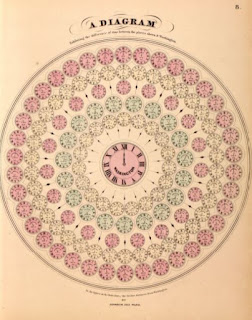
A clock in the middle shows 12:00, labeled "Washington, DC". Five concentric circles of clocks show times at various other cities from around the world.

I came across this item (https://www.loc.gov/resource/g3200m.gcw0013960/?sp=9) from an online copy of the 1862 Johnson's new illustrated family atlas.  The picture intrigued me for lots of reasons, but the one that stuck in my head was the fact that it shows a circle divided into nineteen equal sectors.  That's pretty remarkable, since the 360 degrees in a circle are not nicely divided into 19 equal pieces, and I did not think 19 pieces was one of the divisions possible using compass and straightedge constructions.  (I checked; it isn't.)

I wondered how the draftsperson who created the image divided the circle?  Protractors have been around for centuries, so it is possible that they simply measured the necessary angle with a protractor.  I wasn't satisfied with that, because it seems not quite precise enough.  One would need a really carefully scaled protractor to measure an angle of just under 18.95 degrees.  Maybe the draftsperson just used 19 degrees?  After all, 19 sectors at 19 degrees each would be 361 degrees, which at the scale of the drawing might have been accurate enough.  So maybe they did use a protractor.

But I wanted something precise and elegant.  Something that could be done simply, and would provide an accurate division of the circle, without losing even a fraction of a degree.  And if the process were scalable to divide the circle into any number of sectors, that would be the icing on the delicious mathematical cake.  I had not seen such a process or tool, but its existence seemed possible and even reasonable, even if not with a compass and straightedge.

After some searching, I found an amazing device called ... get ready for it ... the Circle-Divider! (https://babel.hathitrust.org/cgi/pt?id=uiug.30112037739783&view=1up&seq=220&skin=2021).  The article in an 1885 issue of Scientific American Supplement even used 19 divisions as an example. 

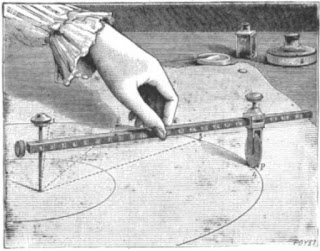
A woodcut illustration showing a hand with a ruffled cuff using a circle divider.

The basic idea uses a small wheel with radius of one unit attached to the end of an adjustable arm, so that it could roll around the perimeter of a circle with radius n units.  (It doesn't matter what units we use, as long as they are the same for the wheel and the rotating arm.)  A mark would be positioned at the bottom of the wheel, and the arm would be rotated around the center of the radius n circle, with the wheel rolling along the perimeter.  Each time the mark on the wheel reaches the lowest point, you can mark that position on the circle, and after one rotation, the circle is divided into n sectors!  (And I love that the illustration shows what appears to be a woman's hand using the device.)

This was beautiful and simple!  All it uses is the formula for circumference, which middle school students typically know.  Since the circumference of the circle on the paper is 2pi times its radius, n, and the wheel has circumference 2pi, the wheel will rotate exactly n times as it rolls around the perimeter of the circle.  (And if your circle divider draws a 19-inch circle with 19 sectors, but you want a five-inch circle with 19 sectors, just make your smaller circle concentric with the larger one, and the sectors you want will match with the sectors you have.)

It's not a traditional compass and straightedge construction, but awfully close!  No need for a ruler (since you can construct a segment n units long, given the length of one unit).  The result is theoretically exact.  And the process is scalable to any size circle with any number of sectors!  This is what I consider a precise and elegant solution to the problem.

Here's the difficulty ... I have not been able to find this tool referenced anywhere but in this short Scientific American article about it.  And the only name I have is "circle-divider" from that article.  It's not part of a typical drafting toolkit, either modern or 19th century as far as I can tell.  A librarian from the Science, Technology, and Business Reading Room at the Library of Congress is helping me track it down, but neither of us has found another reference so far.

I'm not sure if I'm hoping to be able to find an actual circle-divider (I love old tools), or if I'm more excited to actually build one (I've got plenty of cardboard and other scraps around).  Either way, the circle-divider will certainly be making an appearance in my Trig/PreCalc class next year!


Wednesday, February 23, 2022

Basic arithmetic is not so basic

 I found a book on "jettons" a few months ago, as I was working on a project with a Business Librarian at the Library of Congress.  It sat on my desk, mostly untouched until recently, as it was not directly related to my other work.  What intrigued me about the book initially was a diagram like the one below.  It reminded me of a musical staff or an abacus, and reading the caption, I saw that it represented an addition problem: 8342 + 2659.

A grid, similar to a musical staff, with numbers up the left side: 1 on the bottom line, 5 on the bottom space, 10 on the next line up, 50 on the space, up to 10,000 on the top line.  The grid is divided into two sections by a vertical dashed line, labeled "a" running down the middle.  On the left half, there are dots representing 8342, and on the right, 2659.
It's actually a diagram of a counting board that had been used in the 15th and 16th centuries as an aid to calculation.  To add the numbers, start at the bottom.  There are a total of six counters, or jettons, on the bottom line, so five are removed, and one is placed in the space directly above, representing five, and leaving one counter on the bottom line.  Next, there are two counters in the 5 space (the original one shown on the right and the one we just placed), so those are removed, and a new counter is placed on the tens line.  Again, 5 tens make fifty, so all five of the tens counters are removed, and a new counter is placed on the 50 space.  And so on up the board.  You can find the complete process on page 257 of Francis Pierrepont Barnard's The Casting Counter and the Counting Board, published in 1916.*

The process reminds me of the "Exploding Dots" lessons developed by James Tanton, which I had a chance to teach to 7th and 8th graders online last year.  (Shout out to Ms. Anna (@ampacura) for sharing her students with me!)  Exploding Dots can take you from basic counting and arithmetic, through any number base you want, and into polynomials.  (Do our "standard" algorithms work well for all that?)

It's also interesting that the counting board is a combination base-5 and base-10 system.  As I study math history and culture, I'm realizing that base-10 by itself is not the "natural" way to count for everyone.  If you use your thumb as a pointer and the three bones in each finger as one unit, you can count to twelve on one hand, or some cultures historically pointed to not just their fingers, but also to locations on their arms and head to represent numbers up to 27.  I thought I might have the title of the book where I found this information, but I can't find it in my notes right now.  Of course, I can picture the location on the shelves ...

All this to say that there are lots of different ways of representing and calculating with numbers.  And our "standard" algorithms for doing basic operations by hand were developed as a way to save ink and space on the paper.  (Perhaps they also arose as a way of notating how the counting boards were used?)  The more standard algorithm in the 19th century, as far as I can tell was to add numbers from left to right, no carrying needed, but more space required.  Or, you could just do the work in your head, using one of the many methods published in a multitude of pamphlets at the time.  How we do basic arithmetic is definitely not set in stone!  (Unless you're an ancient Babylonian using cuneiform.)


*It's really cool to have old books sitting on my desk.  I have a few from the early 1800s piled there as well.  I am terribly grateful to have the time to actually work inside the Library.

Wednesday, November 10, 2021

Stop Thinking About Math Education Politically

A colleague passed along an article from The Economist, "America's Maths Wars" (https://www.economist.com/united-states/2021/11/06/americas-maths-wars) that discussed how teaching math in the U.S. has become a political issue: "Conservatives typically campaign for classical maths: a focus on algorithms (a set of rules to be followed), memorising (of times tables and algorithmic processes) and teacher-led instruction. ... Progressives typically favour a conceptual approach to maths based on problem-solving and gaining number-sense, with less emphasis on algorithms and memorizing."

The more I read and think about how we learn math, the more annoyed I get by articles like this (and there have been many!), and those that espouse the "best practices" of one side or the other.  The argument that learning math is about the basics versus about conceptual thinking is an old and dusty one, and at the moment, I believe neither side is valid.

People argue that math, like reading, is fundamental, so we need to make sure every student learns it. I don’t disagree with this, but how we teach reading is also hotly debated (https://www.washingtonpost.com/education/2019/03/27/case-why-both-sides-reading-wars-debate-are-wrong-proposed-solution/). I wonder if the perceived importance of math and reading inclines people to think of them as part of the zero-sum "pool of power" and less thoughtful about how to teach them?

I think that math (and perhaps reading?) should be taught more like we teach art, music, or creative writing. In these subjects, we encourage students to get messy and draw/play/write what they know, provide tips and critique on their work, teach basic principles of structure, suggest edits based on historical/cultural norms (hopefully a variety of them), and how to break those norms effectively. And many students find joy in these subjects, and many students who don’t pursue them as careers still continue to draw, play, or write into adulthood.

Teaching math as SOMETHING YOU MUST KNOW AND HERE’S HOW TO LEARN IT misses the point. It loses sight of the fact that there is joy in math, and helping students to get messy and use what they know, providing feedback, and teaching the history and basic structures of the subject are all important parts of the learning process.

The “conservative” idea about “teach the basics” is good: learning a basic addition algorithm is good, but needs to be connected to students’ experiences instead of valued as an isolated skill. If we only focus on the “basics” we suck the joy out of and ignore the students’ connections to the subject.

Likewise, the “progressive” idea about “teach concepts” is good: seeing how the basic addition algorithm and all sorts of methods work are good, but need to be connected to students’ experiences and thinking instead of scatter-shotted without providing focus. If we only focus on the “concepts” we ignore any procedural fluency.

Art, music, and creative writing teachers know how to teach the basics of their fields and provide feedback that values the student’s contribution. They teach some basic techniques and encourage their students to practice those and to indulge their curiosity and imagination. They critique work (including their own), identifying good and interesting ideas and suggesting changes to make the work better. They recognize that not all students will pursue careers in these fields, but help students appreciate and find joy in the work.

The back-and-forth arguments about "best practices" for math education miss the mark, in that they both make assumptions about how ALL students learn math. I learned many years ago that successful teachers build up a repertoire of strategies that they can match to their students, content, and context.* It's not about one way being right and the other wrong. Teaching math is about figuring out when to teach the algorithm and when to let students explore; who needs clear and actionable feedback and who needs to just know if the work is right or wrong; and how to demonstrate perseverance and express joy in the messy, creative, and sometimes straightforward work of doing math.

I agree that math is something you should know, but ignoring the students’ and our own ideas and experiences in order to adhere to a “conservative” or “progressive” curriculum is not the way to help students know it. Do we need to teach basic techniques and have students practice them? Of course. Do we need to encourage students to indulge their curiosity and imagination? Certainly. Let’s also learn to critique their work (and our own) effectively, to identify the good and interesting ideas, and to suggest ways to make improvements. We need to help students appreciate and find joy in math, even if it’s not part of their career plans.


(*I was lucky enough to learn from Jon Saphier and his book The Successful Teacher about repertoire and matching many years ago. I still refer to the book for guidance when I start to feel frustrated about some aspect of my teaching.)