Showing posts with label counting. Show all posts

Saturday, May 7, 2022

Stretching with STEM Yoga!

A few weeks ago, I ran a short online session with the folks in my office.  It's part of a series my fellow Einstein Fellow and I dubbed STEM Yoga, to help stretch our thinking about using primary sources in STEM classrooms.  Most of the rest of the folks in the office have a background in the Humanities, so we've tried to tailor the series to be accessible to a wide audience.

I started out by showing this item (https://www.loc.gov/item/92518152/), and asking everyone to Notice and Wonder, a thinking strategy I've been using for a long time after seeing Annie Fetter give a talk about it at a conference, and later at a Metropolitan Math Club of Chicago dinner (Short video here: https://www.youtube.com/watch?v=a-Fth6sOaRA, and more on "Notice and Wonder" here: https://www.nctm.org/noticeandwonder/.  The Library of Congress uses a variation called "See, Think, Wonder" or "Observe-Reflect-Question" https://www.loc.gov/programs/teachers/getting-started-with-primary-sources/guides/).  

There were lots of items to notice in the picture:

  • It is a woodcut.
  • There are two men sitting at desks with an angel holding books in between.  (I pushed the thinking on this one, and asked "How do you know it's an angel?"  The answer was "She looks like she's floating and she has a halo.")
  • There is a ribbon with words on it, possibly in Latin.
  • One desk has math symbols on it, the other has an abacus.
  • The man with the abacus has a pile of coins by his right hand.
There were some other things to notice as well, and then we went to questions:
  • What do the Latin words mean?
  • Is it really an abacus?
  • Who made the drawing and why?
  • Is this an allegory?
  • Who are these people?
  • What do the numbers mean?
We discussed which questions could be answered quickly, and which my take additional digging.  Quickly, we determined that the Latin writing was two names: Boethius and Pythagoras (on the ribbons near the two men) and the phrase: "Types of Arithmetic".  We also looked at the item record from the Library of Congress (scroll down on the linked page with the image) to find out the appeared in a book by Gregor Reisch in 1503, Margarita philosophica.  This led to all sorts of other questions about who these people were and what else was in the book.  Since that would require additional research, we moved on to the question about the "abacus".

I explained that it was probably not an abacus, as it has no frame, and is probably a medieval counting board.  This would have been made of lines on a table separating the space into regions representing ones, tens, hundreds, and thousands (and more decimal places as necessary).  The beads are actually counters called "jettons" (French for "token"), and the pile of coins under the man's hand were spare jettons*.

I asked if anyone knew how an abacus or counting board worked, and no one was really sure.  So to illustrate, I demonstrated how James Tanton's "Ten-One machine" from his "Exploding Dots" lessons worked.  I showed how the number 5 could be represented by five dots in the first (1s) box, and 10 by ten dots in the first box or one dot in the second (10s) box.  We talked about the meaning of the boxes, and then a bit about language:
  • 12 could be represented by twelve in the one's box, or one 10 and two 1s, but then we might read that as "two-teen", just like 14, 16, 19, etc.
  • Also, numbers like 42, 62, 92 are all read like "four-ty two" (four tens and two) or "six-ty two" (six tens and two), by 22 is not "two-ty two" because the English way to say numbers has some roots in base 20.
  • "Eleventy" (110) was an actual word at one time (and not just from Tolkien)!
  • We can read the number 1200 as "one thousand, two hundred" (one token in the 1000s space and two in the 100s place) or as "twelve hundred" (twelve tokens in the 100s space).
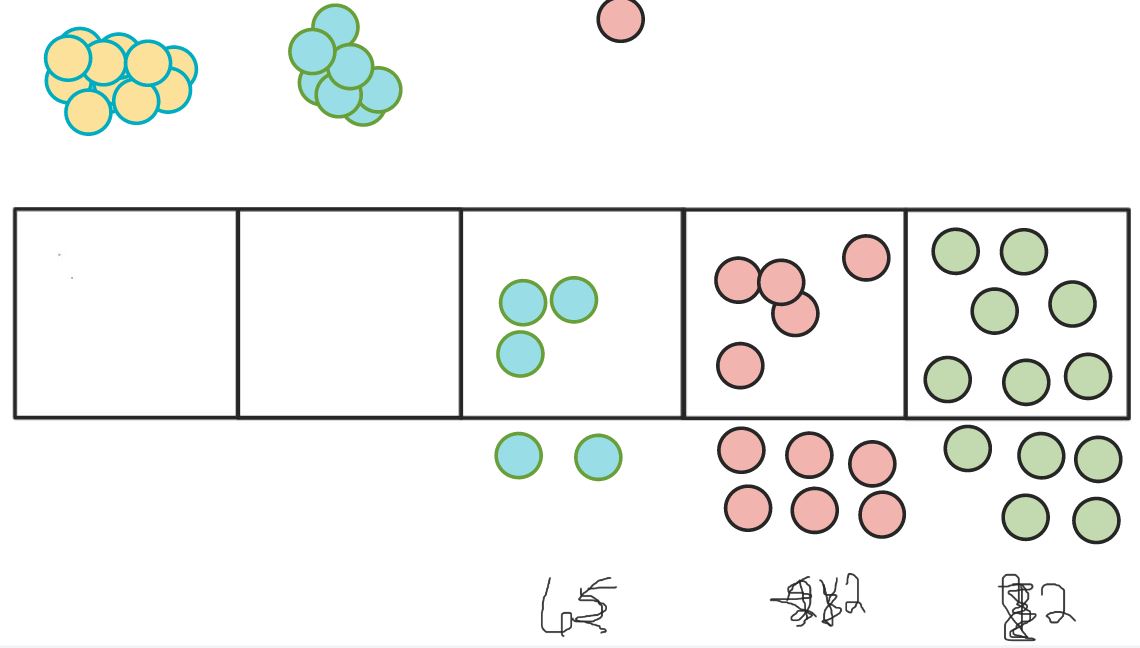
The word play got everyone excited (did I mention they are mostly Humanities folks?) and they were ready to try representing some numbers on their own.  I gave them a google jamboard with tokens and a counting board, and asked them to represent 357.  No problem.  Then I asked them to represent 265 just under that, and add the two numbers together using the tokens.  Here's a screenshot of what one of them did:
Others moved the jettons around:
And several folks explained their thinking, with several different methods.  Some translated to numbers, some worked left to right, and some right to left.  They asked each other a couple questions, and one person who had made a mistake originally talked about what she was thinking and what she learned.

We went back to the original picture, and folks said they could translate the numbers on the counting board, but wondered if the 1s was at the top or the bottom as they looked at the picture, and if the numbers meant anything.  We now had more questions to research.  And those Humanities folks (who often cringe about math) said they enjoyed and understood what we were doing!

As James Tanton would say, it was "brilliant"!

* You can read more about jettons in this book, by Francis Pierrepont Barnard, published in 1916: https://babel.hathitrust.org/cgi/pt?id=mdp.39015017345441&view=1up&seq=4&skin=2021, and this page has another example of addition: https://babel.hathitrust.org/cgi/pt?id=mdp.39015017345441&view=1up&seq=257&skin=2021.
 

Wednesday, February 23, 2022

Basic arithmetic is not so basic

 I found a book on "jettons" a few months ago, as I was working on a project with a Business Librarian at the Library of Congress.  It sat on my desk, mostly untouched until recently, as it was not directly related to my other work.  What intrigued me about the book initially was a diagram like the one below.  It reminded me of a musical staff or an abacus, and reading the caption, I saw that it represented an addition problem: 8342 + 2659.

A grid, similar to a musical staff, with numbers up the left side: 1 on the bottom line, 5 on the bottom space, 10 on the next line up, 50 on the space, up to 10,000 on the top line.  The grid is divided into two sections by a vertical dashed line, labeled "a" running down the middle.  On the left half, there are dots representing 8342, and on the right, 2659.
It's actually a diagram of a counting board that had been used in the 15th and 16th centuries as an aid to calculation.  To add the numbers, start at the bottom.  There are a total of six counters, or jettons, on the bottom line, so five are removed, and one is placed in the space directly above, representing five, and leaving one counter on the bottom line.  Next, there are two counters in the 5 space (the original one shown on the right and the one we just placed), so those are removed, and a new counter is placed on the tens line.  Again, 5 tens make fifty, so all five of the tens counters are removed, and a new counter is placed on the 50 space.  And so on up the board.  You can find the complete process on page 257 of Francis Pierrepont Barnard's The Casting Counter and the Counting Board, published in 1916.*

The process reminds me of the "Exploding Dots" lessons developed by James Tanton, which I had a chance to teach to 7th and 8th graders online last year.  (Shout out to Ms. Anna (@ampacura) for sharing her students with me!)  Exploding Dots can take you from basic counting and arithmetic, through any number base you want, and into polynomials.  (Do our "standard" algorithms work well for all that?)

It's also interesting that the counting board is a combination base-5 and base-10 system.  As I study math history and culture, I'm realizing that base-10 by itself is not the "natural" way to count for everyone.  If you use your thumb as a pointer and the three bones in each finger as one unit, you can count to twelve on one hand, or some cultures historically pointed to not just their fingers, but also to locations on their arms and head to represent numbers up to 27.  I thought I might have the title of the book where I found this information, but I can't find it in my notes right now.  Of course, I can picture the location on the shelves ...

All this to say that there are lots of different ways of representing and calculating with numbers.  And our "standard" algorithms for doing basic operations by hand were developed as a way to save ink and space on the paper.  (Perhaps they also arose as a way of notating how the counting boards were used?)  The more standard algorithm in the 19th century, as far as I can tell was to add numbers from left to right, no carrying needed, but more space required.  Or, you could just do the work in your head, using one of the many methods published in a multitude of pamphlets at the time.  How we do basic arithmetic is definitely not set in stone!  (Unless you're an ancient Babylonian using cuneiform.)


*It's really cool to have old books sitting on my desk.  I have a few from the early 1800s piled there as well.  I am terribly grateful to have the time to actually work inside the Library.