Showing posts with label math problems. Show all posts

Saturday, September 10, 2022

Learning from my students

This week, I saw an algebra student try to find the factors of 15 by repeatedly multiplying numbers by 2 to see if the result might be 15.  I saw an advanced algebra student not remember how to simplify an expression using the order of operations.  And I saw the lesson of two very experienced teachers fail miserably.  (Full disclosure: the two teachers were me and my coteacher.)

But I also saw that algebra student excited to learn how to factor trinomials and differences of squares and know when she whether she was correct or not.  I saw that advanced algebra student smile when he realized he could understand function notation and its relationship with a graph when he used his calculator to do the arithmetic. And I saw two experienced teachers put their heads together to create a lesson that engaged their students, and uncovered some of the reasons why the previous one failed.

Teaching is full of large and small disappointments as well as tiny joys and enormous wonder.  And just like my students, sometimes I fail.  And when a lesson designed for an 85 minute block fails, that's a long 85 minutes.  Especially when you realize it's going off the rails in the first 15 minutes, and you keep scrambling to try to pull it together for the remainder of the block, but you keep failing for more than an hour.  Wednesday was rough.

At the same time, Wednesday had many moments of joy, like the two students who learned how to factor and use function notation.  It also included a group in one class becoming gleeful that they solved a problem unexpectedly by thinking about a different question.  And another class all gathered in one corner of the classroom to learn the definitions of sine and cosine.  (And I had forgotten about these last two moments until I was writing this post; it's not always easy to remember the good stuff when I'm trying to figure out where I went wrong.)

A two by three grid with A in the lower left corner, and B in the upper right. The puzzle was to find how many ways to get from A to B, following lines only upward or to the right.

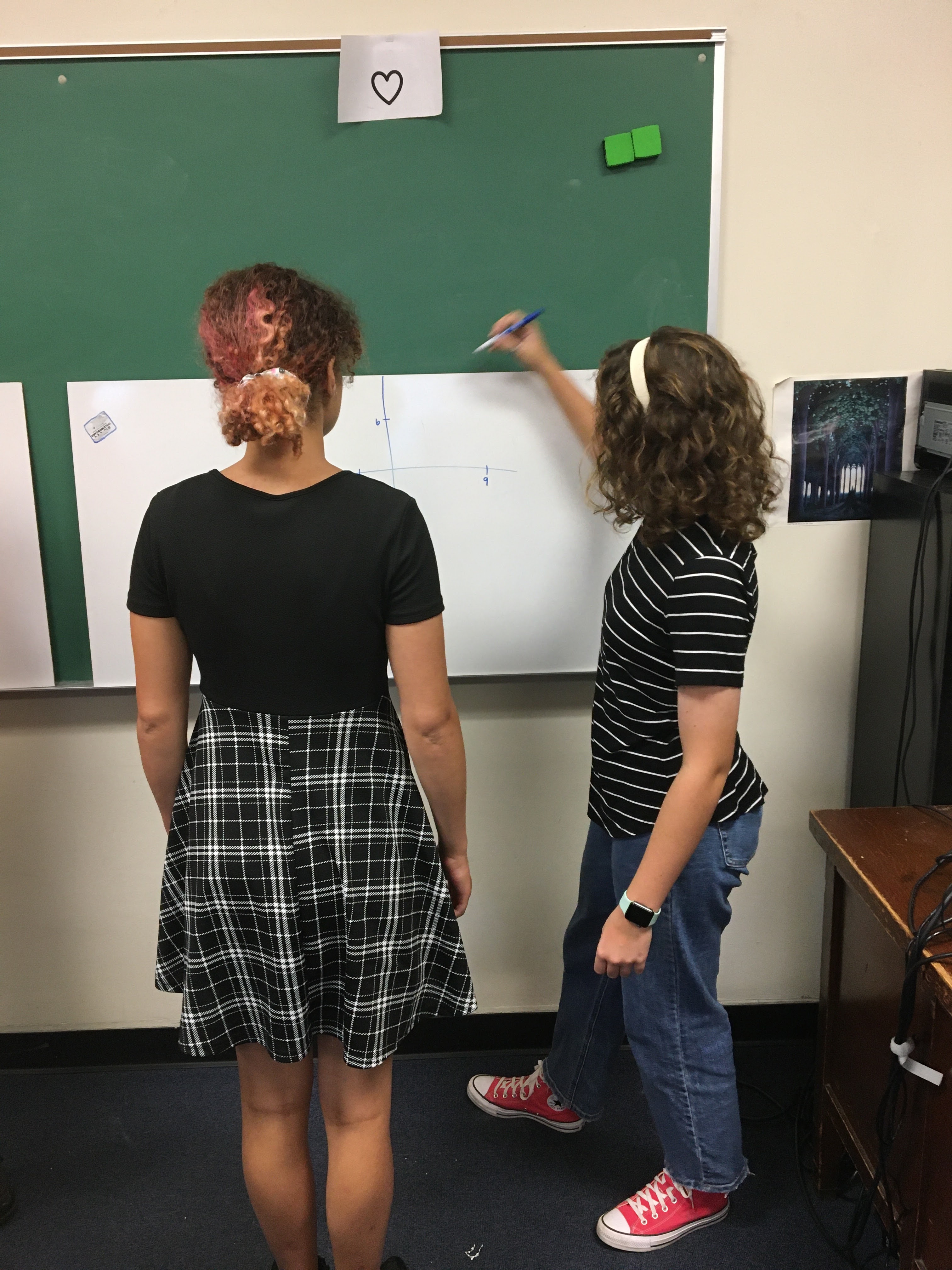
Anyway, my coteacher and I decided to revamp our thinking for Friday's lesson to figure out what went wrong on Wednesday.  We started the lesson with a non-curricular puzzle at the white boards (NPVS's for those of you following along).  The puzzle engaged the students, most groups came up with an answer they were happy with after a few trials, and four groups explained their solving process, two of them inventing notation to keep track of their work*.  Clearly, the students have the ability to think, communicate with each other, and problem solve.

The class then moved the desks out of the way, and put the chairs in a large circle.  We stood in a circle to acknowledge the power of seeing and hearing each other, which took a few minutes, as the kids were feeling a bit squirrelly, probably uncomfortable with the process.  (Who wants to be seen and heard in a math class?!)  After we sat down, my coteacher invited comments about how everyone thought the class was going.  We had asked questions three weeks ago in this format about what everyone hoped for and what success would look like for them in class.  This time, it was quiet for a moment, until one student asked if we really wanted to hear stuff, and could they be honest?  We answered yes, and another student quickly started the conversation with "I don't feel like I'm learning anything in this class."  And that opened the gates.  We talked about all kinds of issues:

  • We don't like the random groups every day.
  • We do like the groups we sit with (which were self-chosen).
  • We don't like working at the white boards.
  • After we work at the white boards, we don't have enough time to practice.
  • We don't know everyone's name.
  • We spend too much time on get-to-know you activities.
  • There's too much homework.
  • We need a break during class.
And so on.  There was one moment that stood out for me:  One of the students said that he didn't think the homework was too much, but he doesn't like doing it, so he just copies the solutions.  A few other kids jumped on him for his opinion about the length of the homework, and he started to retract the statement.  I interrupted to tell him that how he was feeling was perfectly valid, that he clearly spoke only for himself, and that I would not stand for other students ganging up because they shared a different opinion.  As the conversation continued, other students were making general statements about the class, and I continued to push them to speak only for themselves.  More students started using statements that started with "I feel ..." rather than "The class ...".

The circle discussion took longer than I had expected, and we did not get to any math content.  However, the students did agree that sticking with the same random group for the white board work for one week would be okay and that spending less time on the white boards each day and more time consolidating the ideas and then practicing them would be helpful.  The points about taking a break and homework length got tabled for a future discussion.  Everyone helped put the desks back into the pods formation, and we had a few minutes to hang out before the bell rang.  While students were having individual conversations, I checked in with a few students who had not spoken during the circle conversation.  A couple agreed with what was being said, and offered me their viewpoints.  Two students said that they liked the class the way it was, but didn't want to say anything in front of everyone else.  I also thanked the student who commented about his experience with homework for speaking his truth.

After the students left, my coteacher and I agreed that the conversation had been a good one.  While a few students checked their phones during the discussion, the engagement level was much higher that it had been on Wednesday, and the time on phones was significantly smaller.  We discussed the pros and cons of doing a white board problem on Monday, with the shorter class periods, and decided to go for it.  We believe the time at the white boards is some of the most important time we spend, and neither of us is willing to sacrifice that.  Given the length of the conversation with the students, we'll have to reschedule a couple things to account for the missed content time, but overall, we believe the trade-off will be worth it.

We'll see what Monday brings.


*One group used a series of shapes to track their work, another used series of arrows.

Monday, September 5, 2022

Constructive Arguments

Last week felt pretty good.  I'm trying to use "Non-Permanent Vertical Surfaces"* in my math classes on a daily basis, and I'm happy with what I am seeing.  In most cases, I present a problem, send the students to the whiteboards in their random groups, and watch to see where their thinking goes.  Some days, they make wonderful mistakes, and I gather everyone around a particularly interesting whiteboard to quickly talk about the good thinking, the correct paths, and the miss-takes that lead to the very interesting solutions.  Then, I send the kids back to boards, and watch as they discuss what they had been thinking and make revisions.  Some of the best days are when this process goes through a couple iterations, and students thoughtfully revise their work several times.  I always bring them back together afterward to focus on a couple of the solutions, and highlight the vocabulary and formalize the thinking.


It's been great fun to plan and watch, and the kids seem to enjoy the process.  One day this week, I needed some additional space to make some notes, and erased one of the whiteboards, and the students from that group complained that I did so.  They clearly took pride in what they had been thinking (as most kids appear to so, since they often take pictures of their work before the end of class when we erase all the boards).  I apologized to the group for erasing their work prematurely, and promised I would not so that again.


In my Precalculus class, we're starting our unit on the trigonometric functions.  To start class, I sat in the middle of the floor with the kids gathered around, and drew a picture of a bicycle.  Apparently it was a really bad picture, as the pedals were not connected to the frame, and no one was sure which side had the handlebars and which side had the seat.  After straightening that out, I indicated that the bike had ridden over a piece of gum which got stuck to the wheel, and rotated around.  I asked the students to make a graph showing the relationship between the height of the gum from the ground and the time.  Here are some of the results:

Photos of three whiteboards.  The first shows several different types of curvy lines, the second has one curvy line similar to a sine wave, and a circle with some notations, and the third shows a graph with a series of straight-sided v-shapes.
To start the conversation, I asked the students who drew the graph on the left to explain their thinking, as they had a great discussion on whether the horizontal axis represented time or distance traveled.  The other students agreed that I had asked them to graph the height of the gum in terms of time, but spending a little time on the drawings allowed us to preview a cycloid graph, which I plan to discuss later in the course.  

The other two graphs in the picture represent the work that appeared on all the other whiteboards.  The students with the pointy graph stated they believed it would be made of straight lines, since we had said the bicycle was traveling at a constant speed.  Great connection between constant speed and linearity!  That convinced most of the curvier graph groups that they had made a mistake.  A couple curvy graph groups stuck to their ideas and tried to explain that the vertical height of the gum was not traveling at a constant rate, even though the bike was.  It was a great few minutes of argument, after which I suggested we "do some math" to look at the evidence one way or another.
A circle with five radii: one to the bottom, and the other four spaced 45 degrees apart, travelling up the right side of the circle.  The ends of the first four radii are labeled A, B, C, and D respectively.
I drew a version of this diagram on the board, and everyone agreed that since the bike was traveling at a constant speed, the gum would rotate from point A to point C in the same amount of time it would rotate from point B to point D.  The pointy-graph folks were feeling pretty good.  Then, with some special-right triangle geometry (which we had to take a detour to justify, since that was something the students would have seen in Geometry, when they were doing school remotely) we showed that the vertical distance from Point A to point C was shorter than the vertical distance from point B to point D.  Since the BD distance was greater, the gum was moving faster in a vertical line there than along the AC distance.  A small existential crisis began arise among some of the pointy-graph-constant-speed kids, until another student pointed out that if you looked at the wheel edge on, you would see the gum moving only vertically.  Some discussions at the tables ensued, and everyone seemed more comfortable with the graph actually being curvy.

In previous years, these kinds of discussions and willingness to revise work and thinking occurred much later in the year, if they occurred at all.  Using the random groups with the NPVS's, and having a block schedule to give us time to explore made the rich conversations possible.

I can't wait to see what happens this week!

*Non-permanent vertical surfaces and visibly random groups are two of the strategies outlined in Peter Liljedahl's Building Thinking Classrooms in Mathematics.

Sunday, May 22, 2022

I get by with a little help from my friends, and a good math problem.

 It's been a bit of a weird week.  I started out with all sorts of feelings about what's going on in the world, found out I will be co-teaching next year, went to a meeting that was very disappointing, fell behind on some writing I'm trying to finish, saw a really interesting puzzle on Twitter, then got together with some friends online last night to talk and play games.

I've already written about how Monday was going, so let's start with the co-teaching.  While I've met my co-teacher before, I don't know them very well, so we're going to need some time to get used to each other.  I've co-presented at workshops, conferences, and PD sessions lots of times, but having someone with me in the classroom on a daily basis is going to be a bit different.  I'm not sure how well I play with others over the long term.  Also, I really hope we have a common planning period.  That doesn't always happen between co-teachers, and it's going to be be important, for me at least, as I get used to co-teaching.  (I've had aides in my classes before, but this is not the same.)  Planning together will also mean that my planning time will be less flexible, and going back to the bell-scheduled day is going to be a big change from what I am currently doing.  On the other hand, working closely with someone on a daily basis is a great opportunity to learn from them -- about teaching, about the students we share, and about each other.

I'll skip over the disappointing meeting.  It's enough to say that there were lots of missed opportunities for learning, exploration, and collaboration.  As I think about it, I should probably let the meeting organizer know that an exit ticket with some critical remarks came from me.  I dislike providing difficult feedback without taking responsibility for it; I don't think negative feedback without the chance to follow-up is very helpful, and I don't like when it happens to me.

Most of the rest of the week felt unproductive.  My lack of focus on Monday carried through, and I was unable to finish some writing projects whose deadlines are coming up.  I'll have to push a little bit more this coming week.  I'm not disappointed or angry with myself about the delay, and I'm trying hard not to say "I should have done more" because it was probably important for me to process what I was thinking and feeling about current events.

As usual, James Tanton provided an interesting puzzle on Twitter, which led me to a little more research about "Langton's Ant".  It's an interesting situation that might be a good one for a non-curricular problem to use with my math students and an intro to automata for my computer science students.  I added it to my file of interesting math problems.

Finally, I met up online with some friends from the Chicago area whom I have not talked to in several weeks.  We had scheduled a D&D game, but spent the first 90 minutes catching up, and just enjoying each other's company.  We commiserated about current events, celebrated the end of the school year, and shared our hopes for the coming year.  The result is that I'm feeling more positive about the work I am doing, better able to cope with the ridiculousness in the world, and ready to meet the coming week.

The advice to "Check in with each other" is a really good thing, and just as good for the checker as the checkee.

Sunday, May 15, 2022

Two Hundred Years of Progress?

 I had the opportunity to look at some cyphering books from the 19th century this past week, and found a problem I thought interesting.  Ciphering books were books in which students copied math problems and solutions, often after first solving them on a slate and getting the approval of their teacher.  The books served as both math notebooks and reference books, and were often kept by students as they entered the business world, and sometimes passed from one member of a family to another.


Here's a page from a book composed by Christopher Render around 1800.  The book is part of the Ellerton-Clements Cyphering Book collection at the Library of Congress.  The collection has not been digitized, unfortunately, so is only available to those visiting the Manuscript Reading Room of the Library.

The problem at the top of the page reads: "Two men depart from one place suppose them to be James and Jerry.  James starts and travels 26 miles [per] day, seven days after Jerry starts and travels 37 miles [per] day.  I demand in how many days and in how many miles travel will Jerry overtake James?"

The first thing I thought about this was that the problem sounds very much like some of the word problems in modern text books.  Also, who travels 37 miles each day consistently until they catch up with someone else?!  (Apparently, I feeling a little salty about these types of problems.)  It turns out that many of the word problems posed to students in the 19th century came after the statement of a rule, possibly with explanation but often not, perhaps an example, and several (or many) practice problems without context.  The word problem itself provided information very much like the practice problems.  If a type of problem had a number of different variations, the rule would be broken up into cases, each with its own example, practice, and word problems.  After a few rules (and lots of practice problems) there would be a section called "Promiscuous Problems" or what we call in modern books, "Mixed Practice".

There's much more to look at on this page, but I'll write about Christopher's calculations later.  Right now, I just want to sit with the knowledge that many of the currently available textbooks and what students are often currently required to do looks very similar to what was happening over 200 years ago.  Have we really learned so little about how students learn math?!

Wednesday, March 2, 2022

Dividing a Circle

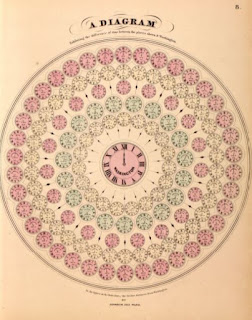
A clock in the middle shows 12:00, labeled "Washington, DC". Five concentric circles of clocks show times at various other cities from around the world.

I came across this item (https://www.loc.gov/resource/g3200m.gcw0013960/?sp=9) from an online copy of the 1862 Johnson's new illustrated family atlas.  The picture intrigued me for lots of reasons, but the one that stuck in my head was the fact that it shows a circle divided into nineteen equal sectors.  That's pretty remarkable, since the 360 degrees in a circle are not nicely divided into 19 equal pieces, and I did not think 19 pieces was one of the divisions possible using compass and straightedge constructions.  (I checked; it isn't.)

I wondered how the draftsperson who created the image divided the circle?  Protractors have been around for centuries, so it is possible that they simply measured the necessary angle with a protractor.  I wasn't satisfied with that, because it seems not quite precise enough.  One would need a really carefully scaled protractor to measure an angle of just under 18.95 degrees.  Maybe the draftsperson just used 19 degrees?  After all, 19 sectors at 19 degrees each would be 361 degrees, which at the scale of the drawing might have been accurate enough.  So maybe they did use a protractor.

But I wanted something precise and elegant.  Something that could be done simply, and would provide an accurate division of the circle, without losing even a fraction of a degree.  And if the process were scalable to divide the circle into any number of sectors, that would be the icing on the delicious mathematical cake.  I had not seen such a process or tool, but its existence seemed possible and even reasonable, even if not with a compass and straightedge.

After some searching, I found an amazing device called ... get ready for it ... the Circle-Divider! (https://babel.hathitrust.org/cgi/pt?id=uiug.30112037739783&view=1up&seq=220&skin=2021).  The article in an 1885 issue of Scientific American Supplement even used 19 divisions as an example. 

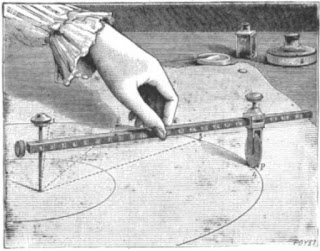
A woodcut illustration showing a hand with a ruffled cuff using a circle divider.

The basic idea uses a small wheel with radius of one unit attached to the end of an adjustable arm, so that it could roll around the perimeter of a circle with radius n units.  (It doesn't matter what units we use, as long as they are the same for the wheel and the rotating arm.)  A mark would be positioned at the bottom of the wheel, and the arm would be rotated around the center of the radius n circle, with the wheel rolling along the perimeter.  Each time the mark on the wheel reaches the lowest point, you can mark that position on the circle, and after one rotation, the circle is divided into n sectors!  (And I love that the illustration shows what appears to be a woman's hand using the device.)

This was beautiful and simple!  All it uses is the formula for circumference, which middle school students typically know.  Since the circumference of the circle on the paper is 2pi times its radius, n, and the wheel has circumference 2pi, the wheel will rotate exactly n times as it rolls around the perimeter of the circle.  (And if your circle divider draws a 19-inch circle with 19 sectors, but you want a five-inch circle with 19 sectors, just make your smaller circle concentric with the larger one, and the sectors you want will match with the sectors you have.)

It's not a traditional compass and straightedge construction, but awfully close!  No need for a ruler (since you can construct a segment n units long, given the length of one unit).  The result is theoretically exact.  And the process is scalable to any size circle with any number of sectors!  This is what I consider a precise and elegant solution to the problem.

Here's the difficulty ... I have not been able to find this tool referenced anywhere but in this short Scientific American article about it.  And the only name I have is "circle-divider" from that article.  It's not part of a typical drafting toolkit, either modern or 19th century as far as I can tell.  A librarian from the Science, Technology, and Business Reading Room at the Library of Congress is helping me track it down, but neither of us has found another reference so far.

I'm not sure if I'm hoping to be able to find an actual circle-divider (I love old tools), or if I'm more excited to actually build one (I've got plenty of cardboard and other scraps around).  Either way, the circle-divider will certainly be making an appearance in my Trig/PreCalc class next year!


Saturday, September 26, 2020

Choose your own adventure!

When I was in middle and high school, I came across a series of books called "Choose Your Own Adventure."  These were really exciting and I read many of them.  I realized this past week, that doing research at the Library of Congress and doing math have a lot in common with these books (including the excitement I felt as a kid.)

While wandering through some LoC collections of online books about games, I came across Games of skill, and conjuring: including draughts, dominos, chess, morrice[1].  "Skill and CONJURING"?!  My inner 13-year-old was immediately intrigued and I spent a bunch of time paging through.  I found the games "Morrice", also known as "Nine-Men's-Morris", and the game called "Fox and Geese".  I had heard of these games before, but never really played them, and since I was looking for things I and other math teachers might use, I found online versions of the games and played against the computer a few times.  I lost.  Every time.  The rules sounded simple enough, but the strategy is something I will need to think about a lot more!  The fact that a computer was always picking the best moves tells me there is some sort of algorithm that can be used, so I do plan on using these games in my classes.  Even though I don't know the strategy.  I'll learn something along with my students.

I continued through the book (choosing a different adventure), and found a bunch of puzzles.  One that intrigued me was this one, from page 91:

Based on the third figure, I realized that the rectangle (I decided that figure 1 was not just a parallelogram, but also a rectangle.) had to be cut into some sort of stair-step shape, and looking at the solution a few pages later, my thinking was confirmed:
Using the stair-steps to get what looked like a square (figure 2) was more intriguing, because I wondered if any rectangle can be cut this way in order form a square, or was there something special about the rectangle in the original problem.  So I posed myself this problem:

Is it possible to cut any rectangle into two equal pieces, so that the pieces may be rearranged to form a square?  I gave myself the constraint of the pieces being equal, and decided to stick with the stair-step division, so that I could at least answer that much of the question.

I needed some way to represent this problem, so I quickly sketched some diagrams and possible algebraic representations on a legal pad:

I didn't know exactly what I was doing, and the algebra was not obvious right away.  There were lots of "adventure paths" here.  I had to decide how many stairs and what variables might represent which aspects of the picture.  I knew that the area of the rectangle and the area of the square had to be the same.  I quickly decided that all the stair-steps needed to be the same size in order to fit the pieces back together.  I also figured out, based on the diagram in the book and some diagrams I drew (the bottom left one in particular) that there would be some number of divisions along the short side of the rectangle and one more division along the long side.  (As I write this, I am wondering if that's always true, or could I arrange the steps another way ...)  I didn't get very far with the problem, and I had other things to do, so I set it aside.

That night, while I was getting ready for bed, my mind wandered back to the problem, and I thought about focusing on the ratio of the two sides of the rectangle. If I divided the short side, x, into n pieces and the long side, y, into n+1 pieces.  Representing the two sides of the square using those variables, I could probably come up with a ratio of the sides.  Since I was tired, I made a note about this idea and went to sleep.  The next morning, I played with this idea and quickly drew a diagram of the rectangle and the resulting square using these pieces, and did some algebra to determine the ratio of y to x:

Since the number of divisions has to be a whole number, I made a table to determine some of the possible rectangles.  I realized that the ratios did not look right, as y/x should have been bigger than one, rather than less than one, and the the pink and black diagram showing the 3x4 rectangle certainly was not going to form a square.  My algebra looked okay, but something was seriously wrong.  When I met an untimely end in a Choose Your Adventure Book, I always backed up a page or two and tried again, so ...

I rechecked my diagrams of the rectangle and resulting square, was happy with the variables, and got a new sheet of paper to start the algebra again.  I immediately saw that I had changed the n+1 from the diagram to n-1 in the first run at the algebra, so redid the algebra on a new sheet, and made a corresponding table of values as well as a few diagrams to verify the work:

It does not surprise me that the base area of these rectangles/squares were perfect square numbers, and I did not think it unreasonable that the table was skipping the odd square numbers; but why was it skipping some of the even square numbers as well?  The resulting side lengths of the squares were increasing in a quadratic sequence. Why not a side length of 8? or 16? Maybe the fact that these are powers of two has something to do with it.  But then why is a side length of 14 not on the list?  Is there something about the factor pairs of the square numbers that worked?  Maybe there's a different way to divide up a rectangle to get these sizes.

As I started to pursue these ideas, more questions and ideas popped into my head, and I realized the adventure could continue:

  • The numbers in each ratio are consecutive perfect squares. What if they're not consecutive?  What happens when I try to make a square?  What happens if they're not perfect squares, like 3/1; how close to a square can I get?  Maybe it's time to get out the ruler and scissors to create some models.
  • I can take any square, and split the sides however I want, making the square 5x5, 6x6, or 14x14.  The units don't matter; it's still a square.  Can I divide the squares into two congruent stair-step shapes to get a rectangle?
  • The limit of the ratio y/x approaches 1 as the number of divisions increases.  What does this mean?
  • Are there other ways to cut a rectangle in order to get pieces that rearrange to a square?  I limited myself at the beginning to two congruent pieces that had a stair-step shape.  What if I removed or eliminated one of these parameters?
  • As I was copying the pictures for this post, I realized that the original problem said "parallelogram", not "rectangle".  Is it possible to cut a parallelogram that is not a rectangle into shapes that could form a square? (I know how to cut a parallelogram to form a rectangle, so this should be possible ...)
  • And what about the original solution shown in the book?  That showed five steps in one direction and six in the other, so according to my formula, the ratio of sides has to be 36/25, right?  The solution also mentioned dividing "a piece of card"; a 5x7 card has a side ratio close to 36/25.  Maybe that's what the puzzle was using.  Did they use 5x7 cards in 1865, when the book was published?
Now I have lots more to explore, including the history of stationery.  I don't know if I'll answer all these questions, because working on one of them may lead to other more interesting paths.  Or some other completely different and shiny math problem will show up and beg me for attention.  I'm always interested to see where the next path takes me ...

References