Saturday, August 6, 2022

Ideas circling in my mind


This week, I've be reading some articles on "Ungrading" and reviewing my notes about democratic classroom techniques.  (For a beginning article on ungrading, see https://www.jessestommel.com/how-to-ungrade/; and https://www.edutopia.org/article/power-democratic-classroom* for democratic classroom.)  I've also received an email from my department chair about how my electronic gradebook must be structured, with categories only for "Summative Assessment" (60%) and "Formative Assessment" (40%).  I have to think about this structure a bit, because I am worried that it still plays into the narrative that the grade matters more than the learning.  Also if "formative assessment" is assessment for learning**, I fear that putting points in the gradebook for this category, it becomes "assessment for points" instead.  My views on points in the gradebook have been evolving ever since I had to start using an online gradebook accessible to students and parents, and I need to think about this new requirement.  I'll write more on that later.

A circle containing a fractal image of purple spirals formed by small squares

As I think about creating a classroom space where students feel like they can trust me to give good feedback and not play "gotcha" with grades, and where they are more interested in learning and doing math than in the points they can earn, I'm recalling the democratic classroom strategy of a classroom circle.  This is an activity that starts with everyone, including teachers and aides standing close together so that everyone can see everyone else, without having to do more than turning their heads.  Ideally, the furniture should be moved out of the way so that the space inside the circle is open; chairs can be placed around the outside so that everyone can sit down at some point.  Creating a good circle is a group effort, and everyone needs to participate to make it as round as it can be.  It's a good format to start a name game or other ice-breakers at the beginning of the year.  Creating the circle is also an opportunity to begin offering feedback, as the teacher (or ideally anyone) can offer comments, such as "The circle looks flat on that side" and the group can make adjustments accordingly.

Given the disconnectedness of the last couple years, I am wondering if creating some kind of script to use every time we move into a circle might provide some consistency and community.  Something along the lines of "We stand in a circle, where we can each see each other and be seen, with nothing to get in the way, with no one more important than another.  We can expand the circle to include others, and if someone is absent, while we can still maintain the circle, it will be diminished."  Still a work in progress ...  One thought I had for the first day, where we only have 15 or so minutes for each class, is to create a circle, and go around so everyone can say their name and pronouns and one thing they would like the rest of the class to know about them.  On the second day, also start in a circle, go around so everyone can say their name and something they know, think, wonder, or imagine about circles, then adjust the script to include some of those ideas.

A circle of handprints, with fingers outward.  Each handprint is made up of several colors.

The part of me that dislikes touchy-feely stuff is asking "Where's the math??!" but I'm willing to ignore that somewhat, for the first week anyway.  I also need to review the new curriculum documents I got this week to see what math I should be including.  More on that next week.

*Most of what I've learned about implementing a democratic classroom has come from the folks at Full Circle Leadership.  Thanks to Chris Fontana for continued encouragement!

**See Dylan Wiliam's Formative Assessment: Definitions and Relationships for more info about this.

Friday, July 29, 2022

About to start a new school year!

My first official day back at school is in two weeks; of course, I'll be there a few days earlier, with the boxes full of materials I took home when I left for my fellowship two years ago.  I am both excited and anxious to return to the classroom.  It's been a busy two years, and both the school and I have changed.

I feel a bit out of practice in front of students, perhaps even more than when I was department chair for three years.  Being away from the building entirely, I feel like I've forgotten what it's like!  I know that's not entirely true and I need to put that bit of worry aside.  Also, I will be teaching the same classes that I taught before the fellowship, so the classes should be familiar.  On the other hand, the school has switched to a block schedule, the curriculum for two of the classes have changed, there has been some turnover in the administration, and I will be coteaching a class for the first time.  So who knows what my year will look like?

I do have some goals.  I want to really work on creating a classroom community using some of the democratic classroom techniques I started trying a few years ago, and adding in some of the team- and relationship-building I have learned in the fellowship.  I also want to use more inclusive and student-centered pedagogy, including what I've learned while researching un-grading techniques, Liljedahl's building thinking classrooms, historical puzzles and games, and, of course, the see-think-wonder and related pedagogies from the Library of Congress.  My more personal goals are to write more about my own practice and about finding the joy of mathematics across the curriculum.  (I'm hoping to write a summary of my work at the end of each week on this blog.)  I also plan to maintain a work-life balance and find time to read and write for myself. 

Picture by Fernando FLeitas from Pixabay 

One big thing I've learned (and continue learning) is that I don't have to get it right the first, or even the nth time.  Living and working remotely (and remotely from home as well) has helped me be more comfortable with failure or with just being in the moment and not worrying about the end result so much.  So my last goal is to remember this when I'm in the classroom as well.

Will it all work out?
Will my worries become reality?
Will I accomplish my goals?
Will the whole thing fall apart?
Who knows?  But if it does come crashing down, I'll just yell "Jenga!" then pick up the pieces and start again.

Monday, June 6, 2022

Out of my comfort zone

There are reasons I chose to teach math.  I like the thought experiments, the proofs, the problems I can think about where all I need is my brain and maybe some paper and a pen.  And I don't expect to have to deal with this:


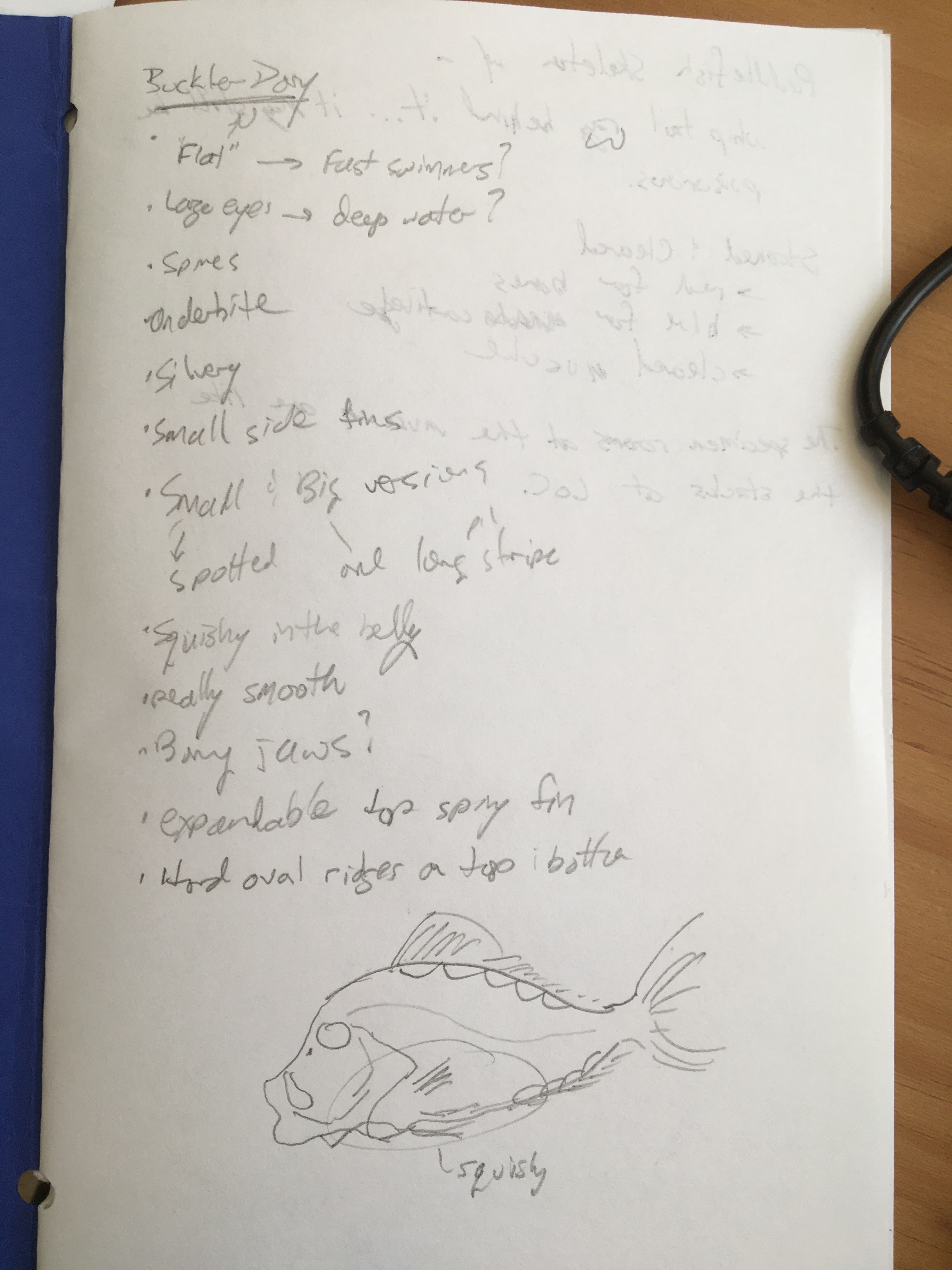
Okay, I only saw this* in one of the specimen rooms behind the scenes at the Smithsonian Natural History Museum.  I did actually get my hands on a buckler dory, however, as I was assigned that fish to notice and wonder about.  Our latest Fellowship professional development day had us learning about fish at the Museum, with folks who specialize in all things fishy.  So when we arrived at the classroom in the SNHS "Q?rious" classroom, we were each given a card which told us which fish we needed to find in the trays around the room to get to know up close and personal.

I found mine pretty quickly, because my card said "bukler dory".  Since it was named "Dory," I looked for something that might bear a resemblance to the character in the animated movie.  It wasn't bright blue, but it did have the right shape:


We spent some time noticing and wondering about our individual fish.  On my tray, there was a juvenile as well as an adult buckler dory.  Other trays had a puffer fish (not the poisonous kind), a sting ray (again, not poisonous, but still sharp), flounder, angler fish, different types of sharks, and something that looked like an alien brain sucker, that I wish I had written down the name of.

All the fish had been caught off the coast of Massachusetts as part of a fish population survey in the spring, and these had all been frozen until they were brought out for us to study.  They were on their way to be skeletonized and preserved for the museum's collections.

I was a little tentative at first about recording my observations of the dory, and just listed what I could see.  Then I got brave and poked it a bit (with a gloved hand) and found that one part of it was kind of like a balloon, while other parts were firm or downright bony.  I actually picked it up to see the other side, and I opened its mouth to peek inside (look at me being all brave!) and that's when one of the Museum's Fellows came over to see what I had found.  Matt just got his (bare!) hands on the thing and pointed out a number of really interesting features.  He opened the mouth all the way and explained how there are bony protrusions in the fish's throat that look a bit like molars and do the actual chewing of food.  (The tiny teeth around the mouth are all pointed inward to keep the food from swimming back out.)  There's also a mechanism to keep the food from passing over the gills.  Matt stuck his fingers in the gills to show me; they were really red because that's the most oxygenated organ on the fish.  (I decided I had already handled the poor thing enough and did not need to stick my fingers in there as well.)

Here's a picture of dory with it's mouth opened all the way.  It works kind of like a vacuum to suck in as much food as it can.  (I won't be able to watch that fish movie the same way again.)

I walked around a bit to take a look at the other fishes.  (If the group of fish you're talking about has more than one species, the plural is "fishes".)  The biology and life science teachers in our group were completely in their element, happily chatting away about their fish, and hugging them like old friends.  Okay, they weren't actually hugging, but they had no problems getting their hands on (and sometimes inside) their fish.  While I don't think I enjoyed the experience as much as some of the teachers, I did have a good time, I learned a lot about fish, and I got to see the Notice and Wonder strategy in a completely new setting.

I also got to look backstage in the specimen rooms, but I'll write more about that later.  In the meantime, here's a selfie of me and dory.  (I'm the one who took the picture.)


*I didn't catch the name of this particular specimen.  It's labeled "OH MY" because it's part of a group of items that curators bring out to show off, and that's the reaction most people have when they see it.  There were several OH MYs in the specimen room we got to see.  I think they did that on purpose.


Saturday, May 28, 2022

Still Angry, but working on it.

Well, the last week has again been pretty upsetting for me as a teacher.  A school shooting and the political responses to it (or lack thereof) have been really disheartening.  Why does there seem to be a political will to do nothing about the gun epidemic (especially from those proclaiming to be pro-life), even as it affects teachers and children?  Why are teachers not trusted to teach children well, but we're hailed as heroes when we go above and beyond to do more for our students?  Why is it that in some places in this country, incorporating social-emotional learning into math class is seen as unnecessary, when we are having lockdown drills at the same time?  Is teaching the racist parts of U.S. history really so much more traumatic than having a shooting in the classroom?  I'm feeling pretty disrespected right now.

I know I am not alone.  I have talked to colleagues who are leaving the profession because of the toxic culture in education.  And a school can say, "we're not like that", but when administrators are more worried that parents will complain about bad grades than they are about their teachers' well-being or credibility, it's clear there is a link between the culture at large and the individual experiences.  It certainly makes me question my decision to go back to the classroom in August.

I hate that I feel this way.  There have been so many teachers in my family, and I've had so many teachers who have inspired me, that I can remember wanting to be a teacher since I was in third grade.  Being a teacher is so much a part of who I am, that it's hard to imagine doing anything else.

So, I am writing this blog post, reading about building Thinking Classrooms*, researching "ungrading" practices, and working on myself to provide a welcoming classroom for all my students.  I've also written my representatives in Congress about gun control.


*Specifically, Peter Liljedahl's Building Thinking Classrooms in Mathematics, Grades K-12.

Image by athree23 from Pixabay with modifications by me.

Sunday, May 22, 2022

I get by with a little help from my friends, and a good math problem.

 It's been a bit of a weird week.  I started out with all sorts of feelings about what's going on in the world, found out I will be co-teaching next year, went to a meeting that was very disappointing, fell behind on some writing I'm trying to finish, saw a really interesting puzzle on Twitter, then got together with some friends online last night to talk and play games.

I've already written about how Monday was going, so let's start with the co-teaching.  While I've met my co-teacher before, I don't know them very well, so we're going to need some time to get used to each other.  I've co-presented at workshops, conferences, and PD sessions lots of times, but having someone with me in the classroom on a daily basis is going to be a bit different.  I'm not sure how well I play with others over the long term.  Also, I really hope we have a common planning period.  That doesn't always happen between co-teachers, and it's going to be be important, for me at least, as I get used to co-teaching.  (I've had aides in my classes before, but this is not the same.)  Planning together will also mean that my planning time will be less flexible, and going back to the bell-scheduled day is going to be a big change from what I am currently doing.  On the other hand, working closely with someone on a daily basis is a great opportunity to learn from them -- about teaching, about the students we share, and about each other.

I'll skip over the disappointing meeting.  It's enough to say that there were lots of missed opportunities for learning, exploration, and collaboration.  As I think about it, I should probably let the meeting organizer know that an exit ticket with some critical remarks came from me.  I dislike providing difficult feedback without taking responsibility for it; I don't think negative feedback without the chance to follow-up is very helpful, and I don't like when it happens to me.

Most of the rest of the week felt unproductive.  My lack of focus on Monday carried through, and I was unable to finish some writing projects whose deadlines are coming up.  I'll have to push a little bit more this coming week.  I'm not disappointed or angry with myself about the delay, and I'm trying hard not to say "I should have done more" because it was probably important for me to process what I was thinking and feeling about current events.

As usual, James Tanton provided an interesting puzzle on Twitter, which led me to a little more research about "Langton's Ant".  It's an interesting situation that might be a good one for a non-curricular problem to use with my math students and an intro to automata for my computer science students.  I added it to my file of interesting math problems.

Finally, I met up online with some friends from the Chicago area whom I have not talked to in several weeks.  We had scheduled a D&D game, but spent the first 90 minutes catching up, and just enjoying each other's company.  We commiserated about current events, celebrated the end of the school year, and shared our hopes for the coming year.  The result is that I'm feeling more positive about the work I am doing, better able to cope with the ridiculousness in the world, and ready to meet the coming week.

The advice to "Check in with each other" is a really good thing, and just as good for the checker as the checkee.

Monday, May 16, 2022

How's your Monday going?

Today, Monday, has been rough.  I have too many thoughts and emotions to focus on much, which sucks because I have a lot I need to focus on.

So, here's me showing my work - the stuff that's going on in my brain right now.  And, yes, putting myself out there is work.  This is not easy.

First, a little background, as I keep this personal, local, and immediate:  I was born three months premature, back in the 1960s, and I spent the first three months of my life in the hospital, in an isolette (a clear box where I could get oxygen and be less exposed to infection).  I also went to Catholic schools from kindergarten through 12th grade.  So when people talk about "abortion rights" or "pro-choice" or "pro-life" or "right to life" it hits me personally.  I know that there have been people like me, who at six months gestation might have survived outside the womb, but unlike me, did not get that chance.  I know that life is sacred, a gift to be cherished, a blessing that requires nurturing, attention, and love.

I went to college and met people of other faiths and belief systems.  I met people whose social-economic situation was vastly different from mine, in both directions.  I met people whose race and culture and outlook on life were very different from what I was used to.  And, as I was taught, I believed that their lives were sacred, cherished, and blessed gifts as well.  Not all of them believed abortion was wrong, some had had abortions, and most believed the decision to end a pregnancy is never an easy one.  I realized that while my faith at the time prohibited abortion, I was not in a place to judge them or their beliefs - who among us has the right to cast the stone and all.

The word "Coexist" written with symbols of different religions and genders, including a peace sign.

As I started my career in the math classroom, I took comfort in the fact that teaching math seemed objective, that I did not need to address difficult conversations around "right to life" or around any other hard topics for that matter.  Racism, sexism, classism, and all the other -isms, I thought, had no place in the math curriculum.

Then I met Hector who was terrified to show his father a failing grade, Ed who was about to be a father at the end of his junior year, Dulce who had to work every day after school to support her family, Marcus whose only meals were the ones he ate at school, Eliza whose anxiety caused her to miss many days of school, Jasmine whose anxiety kept landing her in the dean's office and labeled a behavior problem, and Jessyca who was homeless and sleeping on friends' couches.  And the list goes on, for thirty years.

And in that time, I realized that yes, Black children do have very different experiences than White children; girls do have very different experiences than boys; Hispanic, Asian, Middle Eastern, and most children have backgrounds I can never really know or understand.  But each of them is a life that is sacred, a gift to be cherished, and a blessing that requires nurturing, attention, and love.

Just as I learned, as the father of two sons, that loving and cherishing looks different for different people, so too, loving and cherishing my students looks different for each student, even in Math class, especially in Math class, a subject where the roots of classism and sexism and racism run deep.  So I try to meet students where they are, honor their backgrounds (in math and life), and see them as people, not just a brain to fill with math facts.  Besides, math facts without humanity are boring and devoid of the wonder, joy, and beauty that I see in the subject and in my students.

Which brings me to today.  I saw another tweet from someone stating that "two plus two always equals four" implying that math exists objectively, without human interaction.  I read stories about two more mass shootings over the weekend, one clearly racially motivated.  I heard teachers tell stories about being unable to teach current events in their history classes because it might make someone uncomfortable.*  And my son tells me he is participating in pro-choice protests.  

Black and white photograph showing a hand-drawn sign that reads "Racism is not Patriotism".
All of these things (and more) are rolling around in my head.  And I feel pride for my son taking a stand for what he believes in.  I feel guilt that I have not had the courage to do the same.  I feel anger at government officials for not clearly speaking out against racism and for embracing people who express xenophobic, misogynistic, ableist, or racist views**.  I feel disappointment that people still think we can teach math without thinking about our students.***  I am worried for my students who have to grow up in a society with people who claim to be "pro-life" but still refuse to do anything about gun violence, see violence against BIPOC and LGBTQ+ people as needing only "thoughts and prayers", or see less value in the life of a woman than in the life of someone yet to be born.  I feel helpless and frustrated that I don't know how to fix this.

I know my feelings, those of a cis-gendered, straight white male, are nowhere near as traumatic as what many other people are feeling today.
But, yeah, that's my Monday.
How's yours?


* If topics that make students uncomfortable have no place in school, all math teachers would be out of a job.

**And not just government officials.  I have family members who have "held their noses" about all the -isms a candidate espouses and voted for them just because they are "pro-life".  How do you tell someone you love that you think they are hypocrites?

***And for what it's worth, 2+2 is not always 4; sometimes it's 100, or 11, or even 10; sometimes it's |||| or IV or any number of symbols I can't get blogger to print (yet).  So stop using math to push your right-wing agenda; you're teaching your children to hate not only math, but also those who do it differently from you.

Sunday, May 15, 2022

Two Hundred Years of Progress?

 I had the opportunity to look at some cyphering books from the 19th century this past week, and found a problem I thought interesting.  Ciphering books were books in which students copied math problems and solutions, often after first solving them on a slate and getting the approval of their teacher.  The books served as both math notebooks and reference books, and were often kept by students as they entered the business world, and sometimes passed from one member of a family to another.


Here's a page from a book composed by Christopher Render around 1800.  The book is part of the Ellerton-Clements Cyphering Book collection at the Library of Congress.  The collection has not been digitized, unfortunately, so is only available to those visiting the Manuscript Reading Room of the Library.

The problem at the top of the page reads: "Two men depart from one place suppose them to be James and Jerry.  James starts and travels 26 miles [per] day, seven days after Jerry starts and travels 37 miles [per] day.  I demand in how many days and in how many miles travel will Jerry overtake James?"

The first thing I thought about this was that the problem sounds very much like some of the word problems in modern text books.  Also, who travels 37 miles each day consistently until they catch up with someone else?!  (Apparently, I feeling a little salty about these types of problems.)  It turns out that many of the word problems posed to students in the 19th century came after the statement of a rule, possibly with explanation but often not, perhaps an example, and several (or many) practice problems without context.  The word problem itself provided information very much like the practice problems.  If a type of problem had a number of different variations, the rule would be broken up into cases, each with its own example, practice, and word problems.  After a few rules (and lots of practice problems) there would be a section called "Promiscuous Problems" or what we call in modern books, "Mixed Practice".

There's much more to look at on this page, but I'll write about Christopher's calculations later.  Right now, I just want to sit with the knowledge that many of the currently available textbooks and what students are often currently required to do looks very similar to what was happening over 200 years ago.  Have we really learned so little about how students learn math?!